

My Prediction: Rent Prices Are Going Higher.. Here’s Why
A while back, I wrote about something unusual happening in the housing market: renting the same type of home can cost significantly less each month than owning it.
Since then, that gap has gotten even wider.
Mortgage rates have climbed back into the 7% range, making an already expensive housing market even harder to buy into. Higher home prices aren't the only issue. Buyers also have to contend with elevated borrowing costs, property taxes, homeowners insurance and the other expenses that come with owning a home.
Meanwhile, someone renting a comparable property may be paying substantially less each month.
And I think that's setting us up for something else:
Higher rents.
This is my prediction, and here's the reasoning behind it.
The Gap Between Renting and Owning Has Become Abnormally Large
There have always been advantages and disadvantages to renting versus buying. But right now, the difference in monthly cost can be difficult to ignore.
Take a buyer looking at a $675,000 home.
Let's assume they put 20% down, or $135,000, leaving a $540,000 mortgage. We'll estimate annual property taxes at $13,500 and homeowners insurance at $6,500.
At a 6.7% interest rate, the estimated monthly payment for principal, interest, taxes and insurance is approximately:
$5,151 per month
Now change just one variable.
Keep the home price the same.
Keep the $135,000 down payment the same.
Keep the taxes and insurance the same.
Move the mortgage rate from 6.7% to 7.7%.
The estimated payment becomes:
$5,517 per month
That's approximately $365 more every month—or about $4,386 more per year—without the home becoming $1 more expensive.
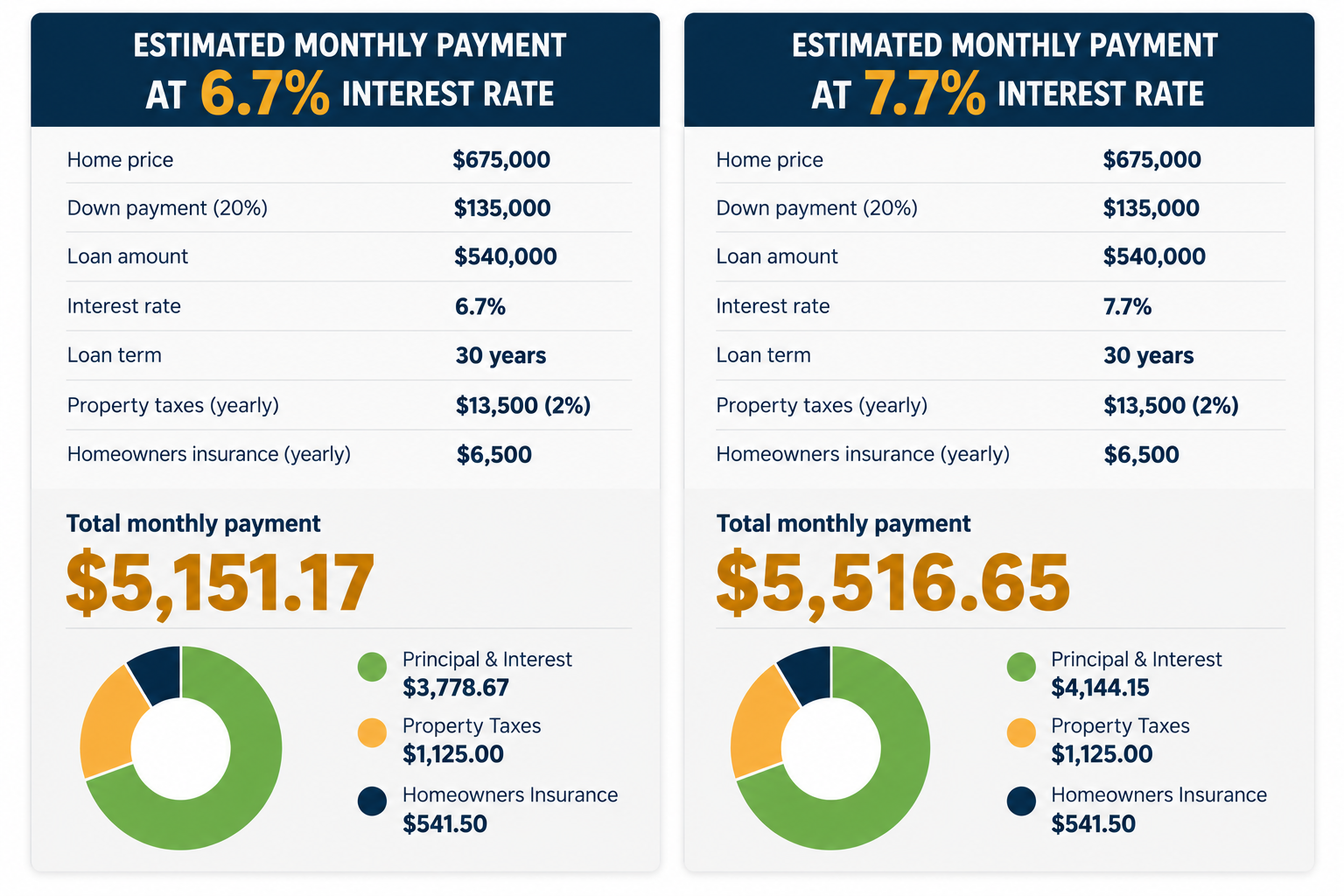
Estimates are for illustrative purposes and assume a 30-year mortgage, 20% down, $13,500 in annual property taxes and $6,500 in annual homeowners insurance. Actual rates, taxes, insurance and payments will vary by borrower and property. Maintenance, HOA fees and other ownership expenses are not included.
And there's another important point here: 20% down is a substantial down payment.
Many buyers aren't putting 20% down. With a smaller down payment, the loan balance and monthly principal-and-interest payment would be higher, and depending on the loan, mortgage insurance could add another expense.
So even this example doesn't necessarily represent the full cost faced by many buyers.
This Rent vs Buy Gap Isn't Normal
This is where looking at history becomes important.
The monthly cost of renting and buying has never moved perfectly together. There have been periods when buying was more expensive, periods when the numbers were relatively close, and even periods when the monthly cost of buying compared favorably with renting.
But look at what has happened recently.
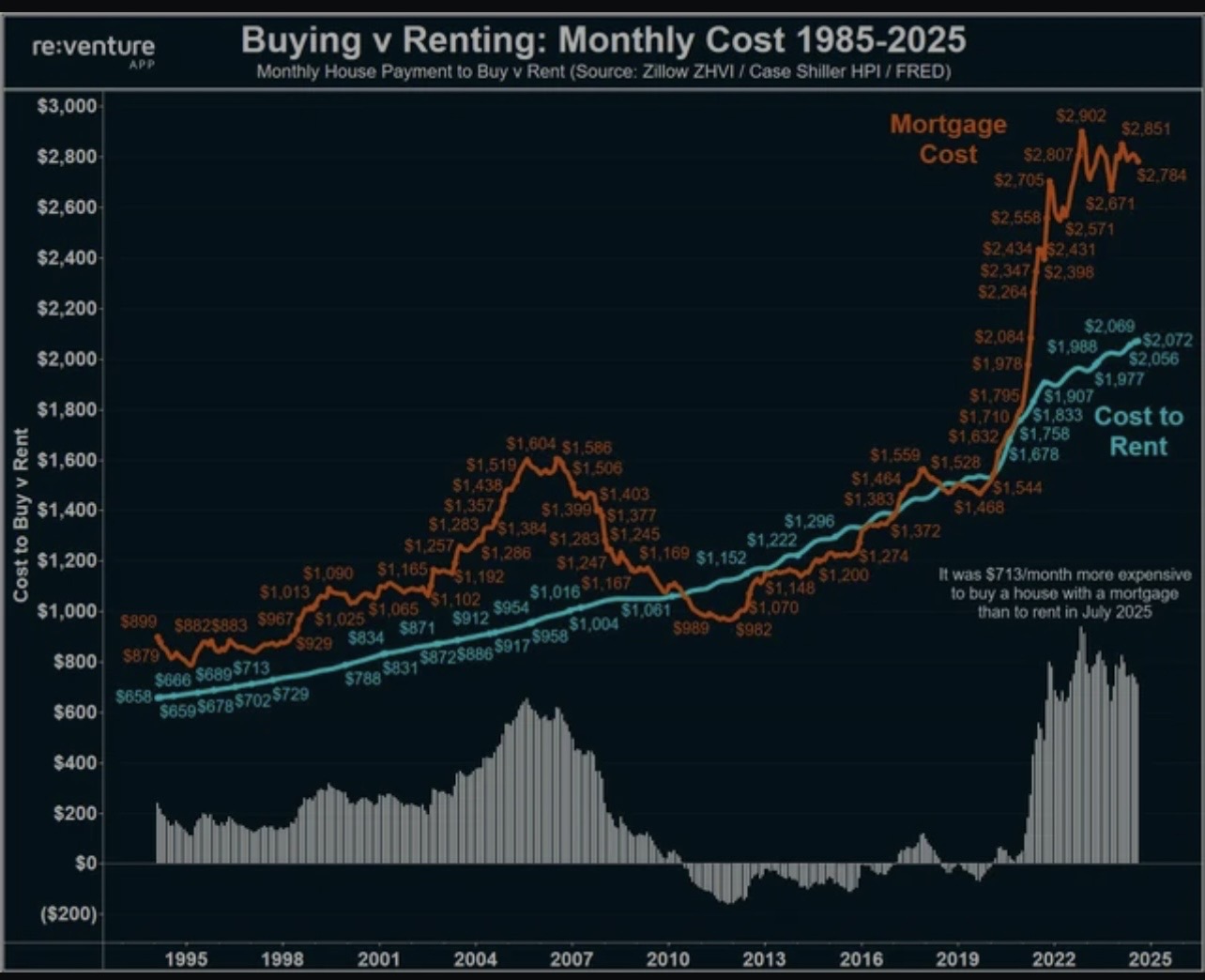
The historical chart makes the current situation much easier to understand.
The cost of buying moved dramatically higher as home prices increased and mortgage rates rose. Rents increased too, but not at the same pace.
That created an unusually large gap between the two.
And that's where I think the next phase of this housing market gets interesting.
What Do Potential Buyers Do When Renting Is Much Cheaper?
People respond to incentives.
Imagine you're considering buying a home and you run the numbers.
You can rent the type of property you want for substantially less than your estimated monthly payment to own something comparable.
Then mortgage rates increase again.
The rent didn't suddenly change.
The mortgage payment did.
So you decide:
“Why would I buy right now? I'll rent for another year and wait for interest rates to come down.”
For one household, that's a completely reasonable decision.
But what happens when thousands—or potentially millions—of would-be buyers reach the same conclusion?
They don't disappear.
They become renters.
And when that many more people start looking for rentals, what do you think eventually happens to rent prices?
They go up.
That's the part of today's housing market I believe a lot of people are overlooking.
Renting Is Cheap Right Now — Relative to Owning
I want to be very clear about what I mean when I say rent is “cheap.”
I'm not saying $3,000, $4,000 or $5,000 per month is cheap.
For many households, South Florida rent is already extremely expensive.
I'm saying renting is cheap relative to the cost of owning a comparable property.
That's a very different statement.
And I don't believe that relationship can remain this favorable to renters indefinitely.
If high home prices and elevated mortgage rates continue keeping potential buyers out of the purchase market, many of those households will remain in the rental market instead.
That means more competition for rentals.
And eventually, I believe that increased demand will put additional upward pressure on rent prices.
What I'm Seeing in South Florida
Working in South Florida real estate, there's another distinction that I think gets lost when people simply look at the number of rental listings available.
Not all rental inventory is equal.
There can be plenty of properties available while it remains difficult to find a good rental.
A clean, updated, properly priced single-family home in a desirable neighborhood is a completely different product from a dated property, a poorly maintained home or a rental that's simply overpriced.
I see this distinction in markets throughout Pembroke Pines, Weston, Davie, Plantation, Cooper City, Miramar, Miami Lakes and other desirable areas across Broward and Miami-Dade.
The properties people actually want are competing for a different renter than the inventory that sits.
So my concern isn't simply, “Are there rental listings available?”
It's what happens to competition for desirable housing if more households that would normally be buyers decide to remain renters.
I think that's where we could see significant pressure.
“But How Will People Afford Higher Rents?”
This is probably the biggest argument against what I'm predicting.
If housing is already expensive, how can rents continue going higher?
The answer isn't particularly pleasant:
People adjust.
Housing isn't optional.
You can delay buying a new car. You can eat at restaurants less frequently. You can cancel subscriptions or postpone a vacation.
But everyone needs somewhere to live.
If housing continues consuming a larger percentage of household income, eventually people's lifestyles and expectations have to change around that reality.
That could mean more income-producing adults living under one roof. Young adults may live with their parents longer. People may have roommates later into adulthood.
Others may choose smaller homes, move farther away from employment centers, accept longer commutes, compromise on neighborhoods or find additional sources of income.
I'm not saying I want any of those things to happen.
I'm saying consumers adapt when the price of something they need increases.
And housing is something everyone needs.
Are We Moving Toward a Renter's Nation?
This is where my bigger prediction comes in.
I believe we're moving toward an America where homeownership becomes increasingly difficult for the average household to achieve—particularly in expensive metropolitan areas like South Florida.
Not because people suddenly don't want to own homes.
Because the financial hurdle required to become a homeowner keeps getting higher.
Home prices are higher.
Borrowing costs are higher.
Property taxes are expensive.
Homeowners insurance remains a major expense, particularly in Florida.
And even the amount of money required for a down payment increases as property values rise.
Meanwhile, those households still need somewhere to live.
So they rent.
And some of them may end up renting for considerably longer than they originally planned.
If that trend continues, I believe we're going to see even more competition for quality rental housing.
And ultimately, that competition gets reflected in price.
So Should You Buy a House Right Now?
Not necessarily.
That's actually one of the most important parts of my argument.
I'm a real estate agent, and I'm still willing to say this:
For some people, renting right now makes more financial sense than buying.
If you can rent the type of home you want for substantially less than it would cost you to own a comparable property, I don't think you should ignore that math simply because someone tells you that you need to buy a house.
But I also wouldn't waste the opportunity.
Use the window.
If renting saves you $500, $1,000 or even more each month compared with owning, don't automatically turn that savings into additional lifestyle spending.
Save it.
Reduce debt.
Build your reserves.
Build your down payment.
Strengthen your financial position.
And when you eventually buy, don't feel like your first purchase has to be your dream home.
Buy something affordable to you. Buy below your means when possible. Build your foundation first.
Maybe that property eventually becomes a rental when you're ready for the next one.
You can buy the dream house later when it makes financial sense for you.
The Risk Isn't Renting — It's Renting Without a Plan
I don't think someone should feel pressured into buying simply because they're afraid they'll miss out.
If renting makes more financial sense today, rent.
The bigger risk is taking today's rent-vs.-buy relationship for granted.
If you're saving $1,000 per month by renting but spending that entire difference, you're not necessarily improving your position.
You're simply benefiting temporarily from cheaper housing.
If rents eventually rise and buying remains expensive, that advantage can disappear.
That's why I believe renters should use this period strategically.
Rent under your means. Save aggressively. Prepare yourself to buy before you absolutely need to.
Because once everyone wants to make the same move, the opportunity usually isn't as attractive anymore.
My Prediction
Could I be wrong?
Absolutely.
Mortgage rates could fall significantly. Home prices could decline. New housing construction could increase supply. Rental supply could grow faster than demand.
There are plenty of variables that could change the outcome.
But based on what I'm seeing, I'm betting on higher rents.
The current difference between renting and owning looks unusually large to me, and I don't believe that gap stays this wide forever.
If purchasing remains expensive, more potential buyers will continue renting.
More renters create more competition.
And over time, I believe that competition will put upward pressure on rental prices—particularly for the homes and neighborhoods people actually want.
So if you're renting today because it's substantially cheaper than buying, take advantage of it.
Save.
Build your financial foundation.
Prepare yourself for what comes next.
Just don't make the mistake of assuming today's relationship between renting and owning is permanent.